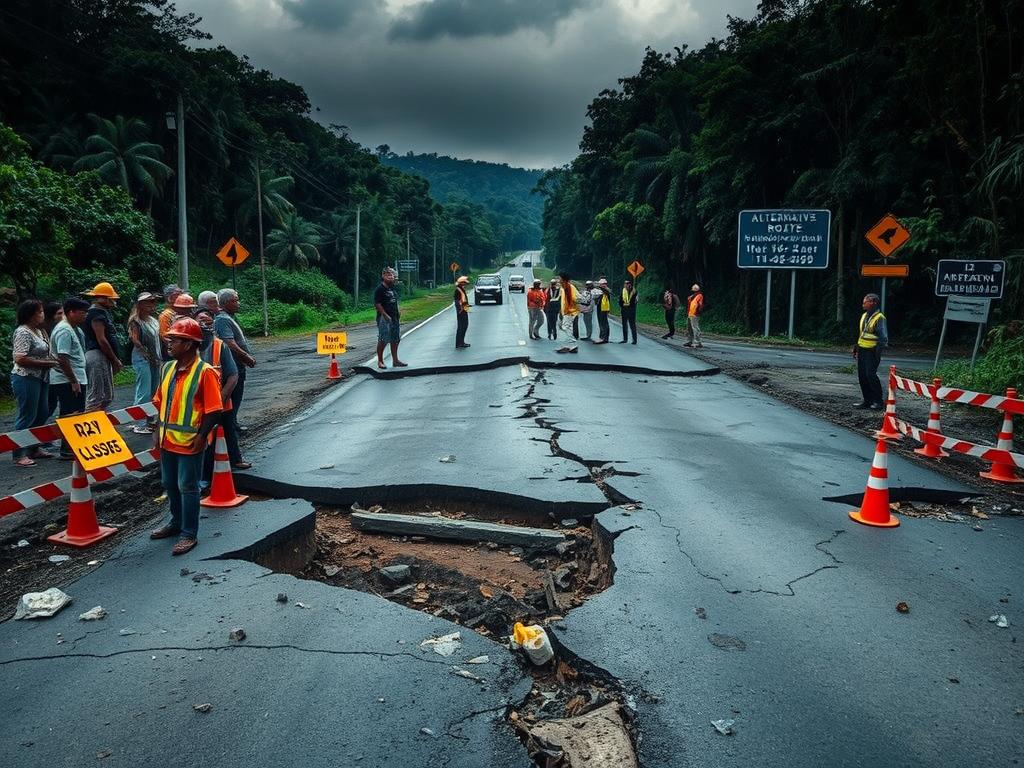
Residents and travelers in the Gua Musang region faced a daunting inconvenience as a significant portion of the D29 roadway at kilometer 11.95 experienced a sudden collapse. This unexpected disruption on the historically reliable Gua Musang-Jelawang route has necessitated a complete closure to safeguard the community from potential hazards. Early reports indicate that structural weaknesses, perhaps exacerbated by recent weather conditions, led to the roadway’s compromise, raising questions about infrastructure resilience in the face of natural elements.
The closure of the D29 route has had immediate repercussions, impacting daily commuters and logistics operations that rely heavily on this vital artery. For many, the road is more than just a transport link; it’s a lifeline connecting the rural areas to more urban centers. Disruptions like this remind us of the delicate balance of infrastructural integrity and the constant demand for maintenance and oversight.
Local authorities are responding to this crisis by rerouting traffic and advising drivers to use alternative roads while assessing the damage. Engineers and road safety experts are on the ground, evaluating the site to determine the safest and most efficient repair strategies. Their efforts underscore the importance of rapid response teams and well-prepared contingency plans to minimize the impact on affected communities.
This incident highlights broader issues concerning infrastructure management, especially in regions susceptible to harsh weather. It serves as a call to action for increased investments in infrastructure technology, predictive maintenance, and regular inspections to prevent similar occurrences in the future. Local governments and national bodies may need to reconsider their budgeting priorities to reinforce these critical assets, especially in regions prone to environmental stresses.
In conclusion, while the closure of the D29 route at Gua Musang presents immediate logistical challenges, it also opens up a broader conversation about infrastructure resilience. As repairs and reconstructions begin, there is an opportunity to adopt more sustainable and resistant construction methods. Through such efforts, we can hope not only to restore connectivity but also to build a more robust and resilient transportation network for the future.