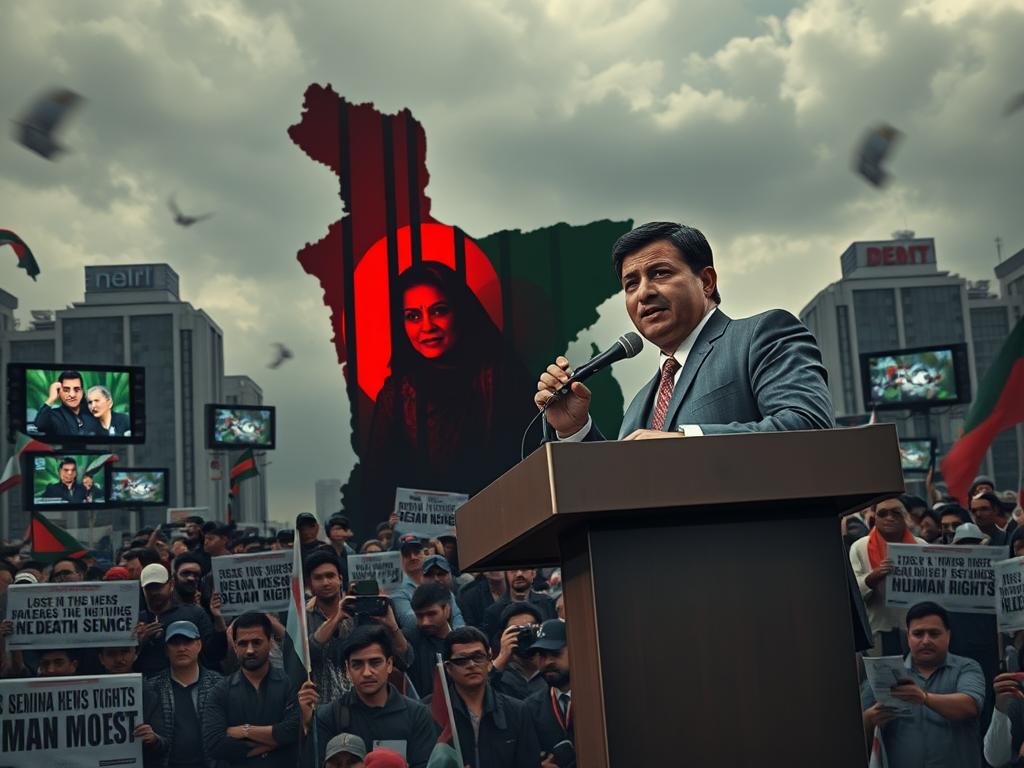
The political landscape of Bangladesh has entered a new phase of uncertainty following the controversial death sentence of ousted Prime Minister Sheikh Hasina. Her son, Sajeeb Wazed, has emerged as a vocal critic of the verdict, categorically denouncing it as the product of an authoritarian government’s agenda. His public declaration paints a picture of a nation grappling with political upheaval and raises questions about the stability of Bangladesh’s democratic processes.
Sajeeb Wazed has vowed to fight the verdict, describing the legal proceedings as a politically motivated spectacle aimed at dismantling his mother’s legacy and the Awami League’s influence. By calling into question the legitimacy of the current ruling government, Wazed not only seeks to clear his mother’s name but also aims to ignite a broader movement to restore what he believes is true justice and democracy in Bangladesh. The statement signifies a deeper conflict between political ideologies that could shape the nation’s future.
Many political analysts view this dramatic turn of events as a potential rallying point for the Awami League, reinvigorating its supporters and bringing international attention to Bangladesh’s judicial integrity. The verdict has certainly galvanized debate over legal and human rights issues within the country, drawing scrutiny from global human rights organizations and foreign governments alike. Placed within this context, the question of Sheikh Hasina’s fate becomes symbolic of larger systemic challenges faced by Bangladesh.
Public opinion within Bangladesh remains sharply divided. Supporters of Sheikh Hasina see the ruling as a blatant misuse of power designed to suppress dissent and weaken democratic opposition, while detractors argue it as timely justice for what they perceive as past transgressions. This division highlights the nation’s pressing need for transparent legal proceedings and renewed trust in governance systems, without which true progress may remain elusive.
As the world watches, the repercussions of this verdict could redefine Bangladesh’s political territory. The prompt response from Sajeeb Wazed underscores not just a personal battle but a historic moment for the nation. How Bangladesh navigates this crisis could set precedents for its democratic identity and the rule of law. In the end, the challenge lies in forging a path toward reconciliation that ensures justice, stability, and unity for all Bangladeshis.