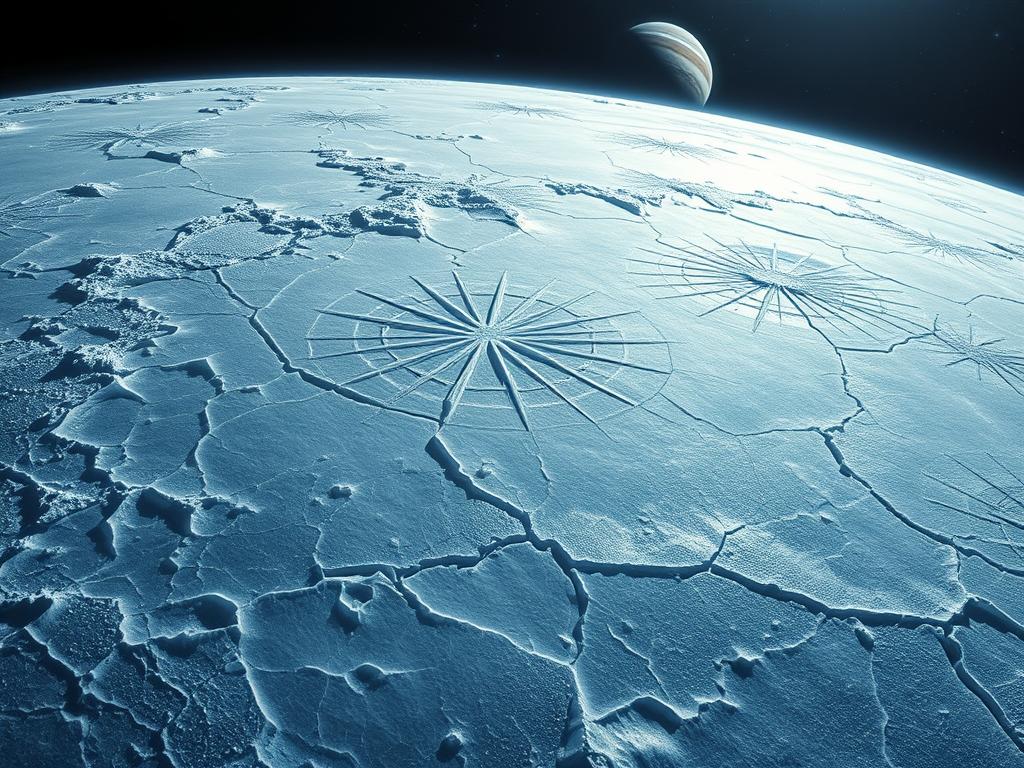
The mysteries of the cosmos continue to captivate scientists and dreamers alike, particularly when they involve celestial bodies as intriguing as Jupiter’s moon Europa. Recent studies led by UCF Physics Professor Lauren McKeown have turned the spotlight on peculiar spider-like formations decorating the frozen surface of this enigmatic moon. These formations, with their intricate, web-like structures, hint at subsurface wonders that are as connected to Europa’s geological narrative as they are to the potential for life beyond Earth.
Europa, with its thick ice crust and underlying ocean, has long been a focal point for astrobiologists. The UCF study delves into whether these spider-like formations are etched by cryovolcanic activity or subsurface movements of salty waters, known as brine pools. This exploration is vital as it sheds light on the moon’s icy shell dynamics and the possibility of nutrient-rich waters beneath its surface—a key consideration in the quest for extraterrestrial life.
What makes this research particularly compelling is the approach used to simulate Europa’s environment. By replicating the extreme cold and dynamic conditions beneath the moon’s ice layer, the team strives to interpret these formations successfully. Understanding how brine migrates and interacts with the ice could not only explain the spider-like patterns but also uncover interactions that generate potential habitats for life. This process of unraveling Europa’s geological tapestry could reshape how we assess habitability on other icy moons across our solar system.
From a broader perspective, studying Europa’s surface features requires more than solving intriguing geological puzzles. It challenges our understanding of life’s potential adaptability. What might appear as environmental extremities on Earth could very well be the norm elsewhere. The spider formations aren’t merely lines etched in ice—they could be the threads weaving a larger tapestry that connects surface observations with the hidden oceanic possibilities underneath.
In conclusion, the melding of planetary science and astrobiology opens new avenues for exploring other worlds. Europa’s enigmatic surface invites a deeper inquiry into its hidden secrets lying beneath vast ice sheets. As studies like the one led by McKeown continue to evolve, each discovery not only sparks curiosity but also enhances our understanding of life’s resilience and adaptability in the universe. The spider-like features on Europa are more than celestial curiosities; they are potent symbols of potentiality, urging us to look beyond and beneath.