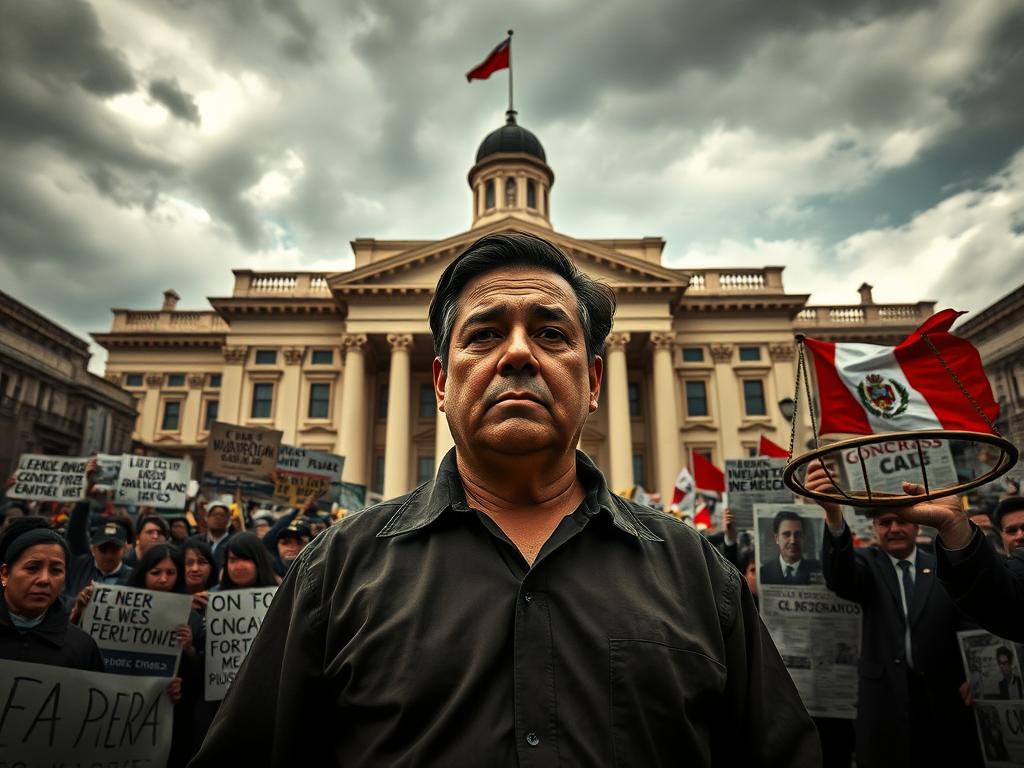
In a dramatic chapter of political turbulence, Peru’s former president, Pedro Castillo, has been sentenced to over a decade behind bars for attempting an audacious power grab. Castillo, often hailed as the ‘president of the poor,’ has experienced a steep downfall. His attempt to circumvent parliamentary protocol by dissolving Congress in order to avoid impeachment now sees him facing 11 years in prison. This verdict marks a significant moment in Peru’s volatile political landscape, a stark reminder of how power dynamics can shift dramatically overnight.
Castillo’s rise to power was marked by his populist platform and promises to uplift Peru’s impoverished communities. His rhetoric resonated with those who felt marginalized in the country’s socio-economic hierarchy. However, his methods of governance quickly came under intense scrutiny. The attempt to rule by decree, reminiscent of autocratic traditions, was seen as a betrayal to democratic norms. Castillo’s actions have sparked widespread debate about the delicate balance of authority and governance in a democratic society.
The 11-year sentence handed down by Peru’s Supreme Court underscores a clear message: even those elected by widespread support must adhere to constitutional protocol. Just because a leader garners the support of the disenfranchised does not grant carte blanche to alter the political framework at will. This decision aims to reinforce the principles of checks and balances, a cornerstone of democratic governance. It sets a new benchmark for accountability in Peruvian politics, ensuring that democratic values are protected from impulsive authoritarian maneuvers.
However, the implications of Castillo’s conviction extend beyond the courtroom. His sentence might further polarize an already divided nation. Supporters view him as a victim of an elite conspiracy, while critics argue that his punishment is justified to safeguard democratic institutions. This dichotomy reflects deep societal chasms that continue to resonate within Peru’s political discourse. What remains critical is how these divisions will evolve and what effect they will have on future electoral outcomes.
In conclusion, Castillo’s sentencing serves as a critical juncture for Peru. It highlights the fundamental need for leaders who can navigate the fine line between populism and democratic integrity. Moving forward, it is imperative for Peruvian citizens and politicians alike to engage in a dialogue that prioritizes unity and democratic resilience. Only then can the country overcome its current challenges and lay a foundation for sustainable governance that aligns with the aspirations of all its people.