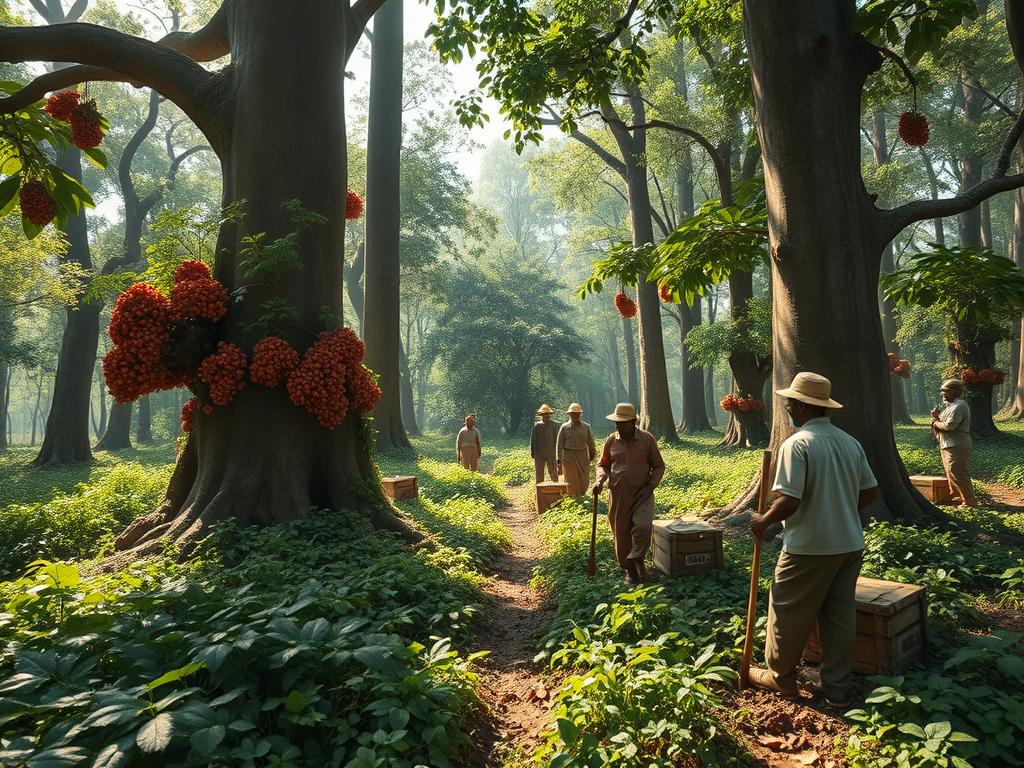
The year 1925 marks a significant chapter in the forest management history of Bihar and Orissa, as documented in official reports from that time. These reports offer a fascinating glimpse into experimental efforts, particularly focusing on lac plantations. Often overshadowed by mainstream agricultural pursuits, lac cultivation reveals an intriguing cornerstone in rural and economic development strategies adopted nearly a century ago. While the world today grapples with sustainable practices and future-ready solutions, revisiting these efforts sheds light on how our predecessors approached environmental stewardship and economic diversification.
Lac, a natural resin obtained from insects, historically held importance due to its use in varnishes, dyes, and even jewelry. The decision to embark on targeted lac plantation research in the forests of Bihar and Orissa was not only forward-thinking but also economically strategic for the time. By encouraging the cultivation and harvesting of lac, colonial administrators foresaw a dual benefit: boosting local economies while maintaining the biodiversity and health of regional forests. This initiative reflects an early adaptation of what we now call agroforestry—where ecological and economic aims converge.
The research and experiments in lac cultivation were indicative of a growing understanding of ecological restoration and sustainable land use. In the face of rapid deforestation and land degradation that plagued many British colonies, projects like these were critically important. Looking back, it becomes clear that such initiatives were early attempts at balancing economic nitrogen with environmental accountability. This thoughtful approach laid foundations for what could have become a more sustainable forestry practice in the region.
However, despite these ambitious beginnings, the full potential of lac plantations might not have been fully realized due to various socio-political factors. Changes in governance, shifts in economic focus, and the eventual struggle for independence likely overshadowed the continuity of such ecological endeavors. This underlines a larger trend where short-term political and economic priorities frequently sideline long-term sustainability goals—a challenge that persists even today.
In retrospect, the 1925 venture into lac cultivation serves as a timeless lesson. It reminds us of the untapped potential within integrating ecological management with local economies. As we face modern-day environmental challenges, revisiting and learning from such pioneering efforts could inspire innovative solutions. Indeed, history might be telling us that the seeds of a sustainable future were planted long ago—in the shaded groves of Bihar’s forests—ripe for us to nurture and grow.