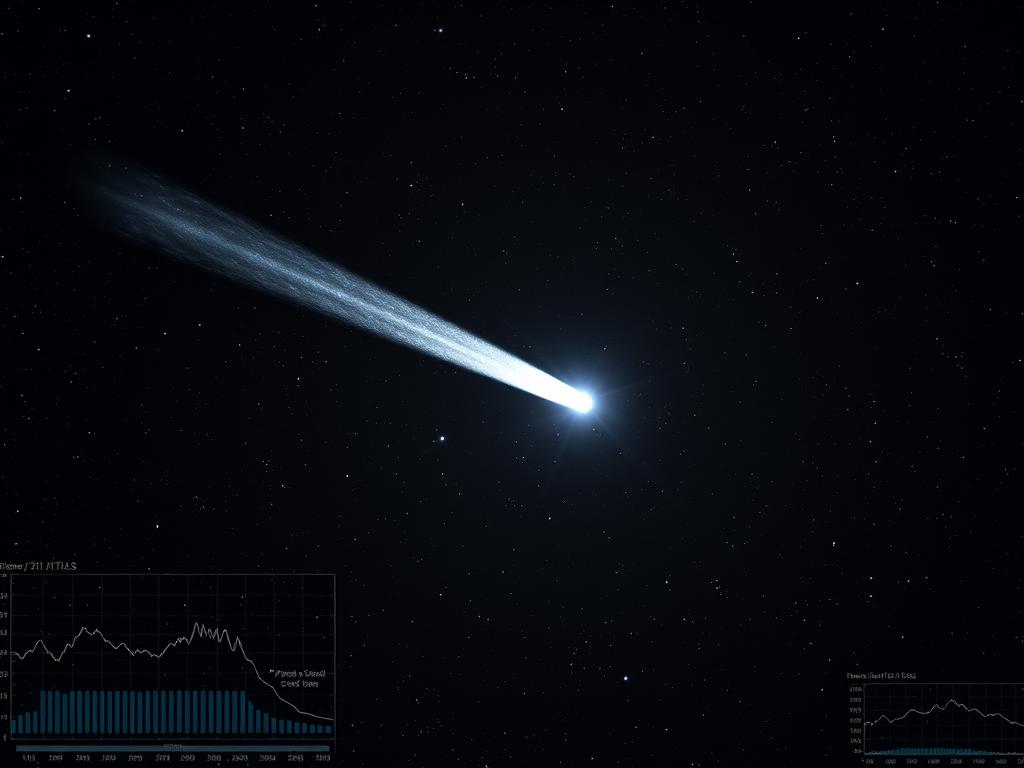
The cosmos has long been a playground for the curious, igniting imaginations with every mysterious object that glides through the pitch-black tapestry above us. Recently, the astronomical community and space enthusiasts were buzzing over 3I/ATLAS, a celestial object whose origins and nature stirred conversations ranging from scientific inquiry to wild extraterrestrial theories. Now, a collaboration between Indian and NASA experts has conclusively identified 3I/ATLAS as a comet, putting to rest the fantastical hypothesis that it might be an alien spaceship.
3I/ATLAS, captured in massive telescopic eyes, sparked such intrigue primarily due to its unusual trajectory through our solar system. Initially discovered by the Asteroid Terrestrial-impact Last Alert System (ATLAS), it exhibited characteristics unlike most comets we’ve observed before, leading to high speculation. However, after extensive analysis and data comparison led by seasoned researchers, the object has been classified as the third detected interstellar comet, following its predecessors with similar cosmic credentials.
While for some the debunking of the alien ship theory might bring disappointment, the revelation is a win for science, revealing more about the dynamic nature of our universe. This discovery underscores the importance of critical analysis and collaboration in space research. By identifying the spectral fingerprint unique to comets, experts provide pivotal insights into the composition and origin of these travelers, enhancing our understanding of what lies beyond the reach of our solar system. It’s this rigorous investigative spirit that continues to expand the frontiers of human knowledge.
The idea that an unknown celestial body might be an alien craft has always been more a testament to human imagination than evidence-based science. Such theories, though often exaggerated, do fuel public interest and compel scientists to uncover the truth, which can only be beneficial as it drives deeper investment into space exploration and technological innovation. Therefore, while 3I/ATLAS may not have been a spaceship, it carries profound implications for our understanding of the interstellar medium and the materials that fill the vast spaces between stars.
In conclusion, the identification of 3I/ATLAS as a comet serves as a reminder of the importance of the scientific method in demystifying the universe. Each celestial discovery speaks to the fragments of ancient cosmic stories they hold. As we peel back each layer with our growing technology and expertise, we not only find answers but also cultivate new questions. The stars, with their enduring allure, continue to inspire, challenge, and beckon us toward a future where understanding our universe is boundless and irrevocably intertwined with the human quest for knowledge.