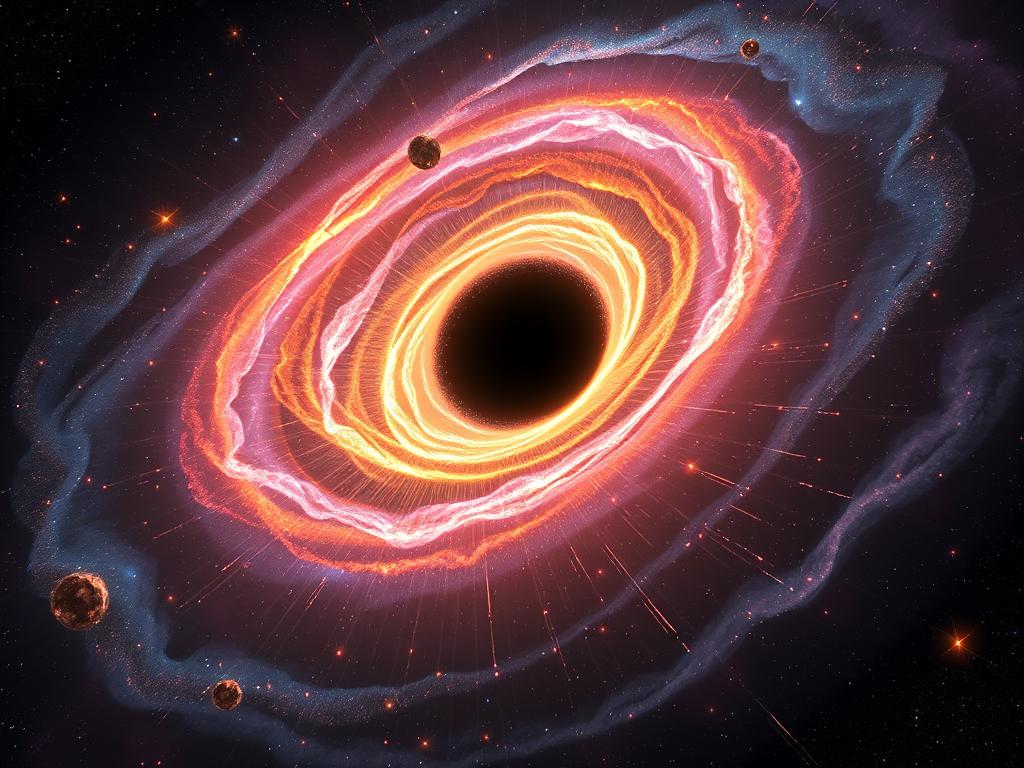
The universe continues to unfold its mysteries with each passing discovery, and the James Webb Space Telescope (JWST) appears to have unearthed one of its most thrilling secrets yet: a potentially record-breaking supermassive black hole from the universe’s dawn. This cosmic behemoth, observed from a period known as the Cosmic Dawn, may be the farthest and earliest of its kind ever detected, offering astronomers a fresh perspective on how such colossal entities formed in the early universe.
The revelation comes as no surprise, given the telescope’s cutting-edge technology designed to look deeper into space than ever before. Utilizing infrared capabilities, the JWST can glimpse the universe as it was over 13 billion years ago. This new finding is not merely a testament to the telescope’s prowess but also a significant addition to our understanding of cosmic evolution during the universe’s infancy, a time when galaxies and black holes were both new entities on the cosmic stage.
What makes this supermassive black hole particularly intriguing is its ‘greedy’ nature, as noted by the European Space Agency. It is rapidly consuming material, fueling its growth at an astonishing rate. This observation challenges existing theories about black hole formation and growth rates, prompting astronomers to reconsider how such massive entities could reach colossal sizes within the universe’s first 500 million years. Such rapid accretion suggests that the processes involved are far more complex than initially thought.
Analysts from around the globe are eagerly delving into the data provided by the JWST to understand the conditions that led to this supermassive black hole’s formation. One of the most prevailing hypotheses is that the seed that led to this gigantic black hole might have originated from a direct collapse without following the prolonged traditional pathway from smaller, stellar black holes. Unraveling these initial conditions could redefine our concepts regarding early universe dynamics and structure formation.
As we decode these celestial puzzles, the James Webb Space Telescope continues to prove its worth as a window to our universe’s deep past. Its findings are not only rewriting cosmic history but are also potentially unlocking secrets that could explain the birth and evolution of the most massive structures we have ever known. As these discoveries unfold, they remind us of the incredible vastness of the cosmos and our endless quest to understand our place within it.