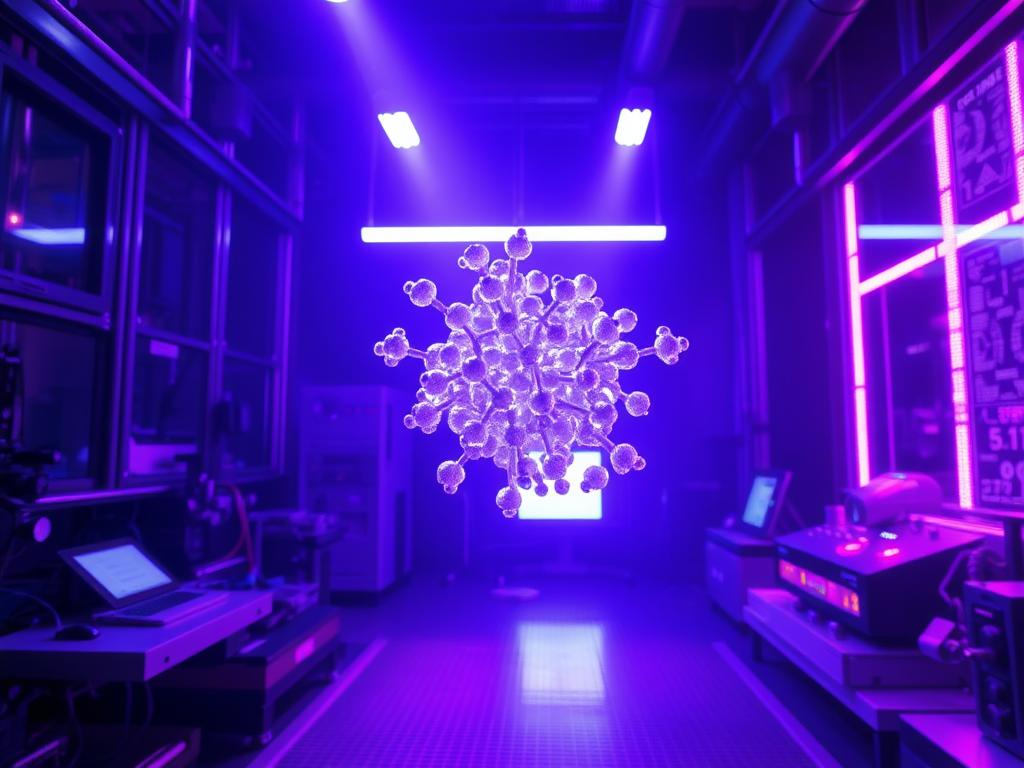
In a groundbreaking stride for the scientific community, researchers have achieved a feat long pursued but never before completed: using deep ultraviolet (UV) light to trap stable molecules through laser cooling. This innovative technique marks a new chapter in the realm of molecular physics, offering unprecedented opportunities to manipulate and study molecules at temperatures near absolute zero. This discovery not only expands the horizons of laser cooling but also opens up new potential applications across various scientific fields.
Laser cooling, the process of slowing particles through the emission of light, enables scientists to precisely control molecular movement and energy. Until now, this approach was largely confined to atomic particles, with considerable difficulties encountered when applied to complex molecules. The leap from atom to molecule has been likened to climbing a steep summit, where once the challenges seemed insurmountable. However, with this breakthrough in using deep UV light, researchers have found a way to gently coax stable molecules into a state of near immobility, setting a precedent for what can be achieved moving forward.
Deep ultraviolet light plays a crucial role because its short wavelength provides the necessary energy to interact effectively with molecules, cooling them to an ultra-low energy state. This process doesn’t just freeze molecules in place; it allows researchers to examine them more intricately, leading to deeper insights into their properties and behaviors. The implications are vast, potentially revolutionizing fields such as chemistry and materials science, where understanding molecular structures and interactions is vital to innovation.
From a practical standpoint, the ability to trap stable molecules holds significant promise for the development of new materials and the advancement of quantum computing technologies. By observing molecules in a slowed state, scientists can investigate the nuances of molecular interactions with greater clarity. This could lead to the creation of novel compounds and materials with unique properties, as well as enhance our understanding of molecular dynamics in condensed environments, a key factor in the progress of molecular electronics and photonics.
In conclusion, the successful trapping of stable molecules using deep ultraviolet light signifies a major leap forward in molecular physics and laser technology. It demonstrates how creative application of existing principles can lead to transformative discoveries, reshaping our approach to scientific challenges. As researchers continue to explore this new frontier, we can anticipate further breakthroughs, potentially transforming everything from medical research to material sciences, and ushering in a new era of molecular exploration and innovation.