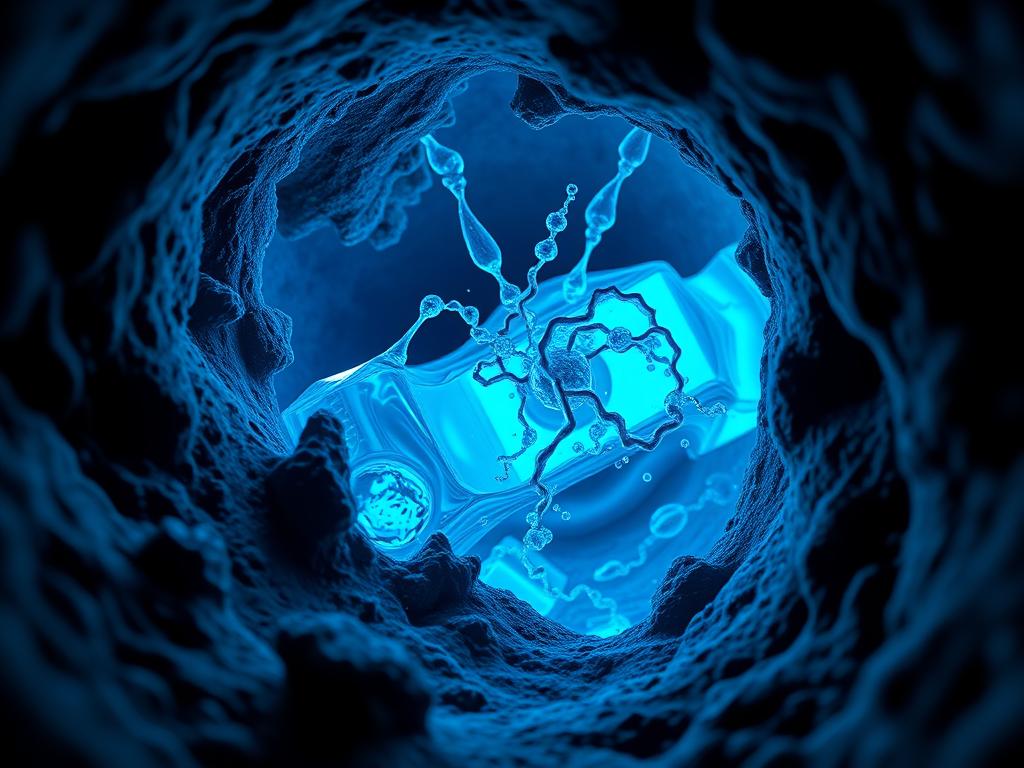
Water is often hailed as the elixir of life, vital for all known forms of existence. While its role is well-celebrated on a macroscopic level, recent discoveries suggest that water behaves even more intriguingly in the minute crevices of the microscopic world. Scientists have found that when water is confined to these tiny spaces, it transforms into a ‘highly energetic’ state. This discovery opens up new conversations about the seemingly mundane molecule that continues to surprise researchers with its hidden capabilities.
Confined water, essentially water trapped in microscopic nooks and crannies, exhibits properties that are significantly different from its freely flowing counterpart. This form of water influences molecular binding—an interaction pivotal in countless biological and chemical processes. These insights could shed light on phenomena ranging from the formation of proteins in our bodies to the creation of minerals in geological formations. Such revelations underscore just how much remains to be explored about the fundamental elements that constitute our world.
The idea of ‘energetic water’ might sound esoteric, but its implications are tangible and wide-reaching. Understanding this variant of water could revolutionize fields such as nanotechnology and material science. Researchers are keen to leverage this knowledge to innovate how we design molecules for specific purposes, potentially leading to breakthroughs in drug delivery, material synthesis, and beyond. The newfound perspective on water challenges us to rethink processes that have been taken for granted.
This discovery also prompts us to reflect on the manifold mysteries still hidden within the familiar veneer of everyday substances, shrouded in complexity at scales invisible to the naked eye. Perhaps this serves as a metaphor for knowledge itself: the more we learn, the more layers remain to be unveiled. Just as the energetic nature of water in confined spaces invites us to reconsider established scientific tenets, it also inspires us to look beyond the obvious, challenging the boundaries of our understanding.
Ultimately, the recognition of water’s dynamic behavior in confined spaces is a gentle yet powerful reminder of the unseen vigor that exists within our world. It encourages not only scientists but all of us to appreciate the profound intricacies of nature. As we continue to delve into the essence of what makes water ‘water,’ we are reminded of the intricate tapestry of life—constantly evolving, endlessly fascinating, and magnificently intricate.